 english
 français
 Deutsch
 Italiano
 Русский
 Español
 português
 Nederlandse
 ελληνικά
 日本語
日本語
 한국
한국
 العربية
 हिन्दी
 Türkçe
 indonesia
 tiếng Việt
 ไทย
ไทย
 বাংলা
বাংলা
 فارسی
فارسی
 polski

Bathroom and Kitchen Ceilings
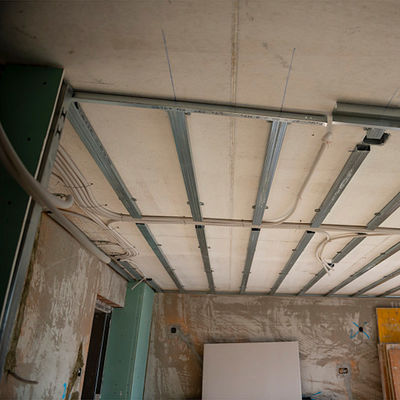
Warm air, steam and weak ventilation make ceilings more sensitive in humid regions. Moisture resistant board is often selected when a clean gypsum ceiling finish is required but standard drywall feels risky.

|

| एमओक्यू: | 1200 |
| कीमत: | $2.30-3 |
In tropical, coastal and rainy climate regions, moisture is not limited to one bathroom or one kitchen. The whole building may face high air humidity, frequent rain seasons, warm indoor air, poor ventilation and longer material storage time before installation. For importers and contractors, this changes the way interior wall and ceiling boards should be selected.
Moisture resistant gypsum board is a practical option for damp interior projects in high humidity climates. It is commonly used for bathroom ceilings, kitchen walls, laundry rooms, apartment corridors, utility rooms and protected interior partitions where standard drywall may not match the climate risk.
In a dry climate, the room condition may be stable. In tropical or coastal markets, moisture pressure is part of daily use and construction logistics.
A buyer in a high humidity region may not only worry about bathrooms. The concern can start from the container, warehouse and jobsite. If gypsum boards are stored in a damp warehouse, left on site before installation, or installed in rooms with weak ventilation, the risk of surface damage, edge softening, joint cracking or early repair can increase. This is why material choice, packing and site handling should be considered together.
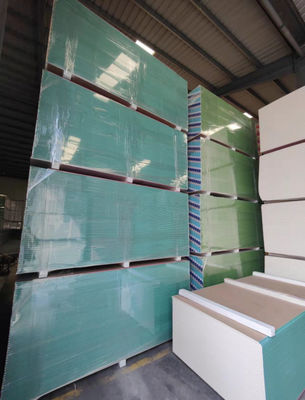
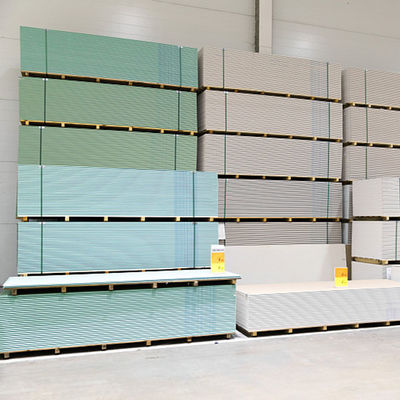
Moisture resistant gypsum board is designed for interior areas where humidity is higher than normal dry rooms. It is also called green plasterboard, MR drywall panel, water resistant plasterboard or humidity resistant gypsum board in different markets. The green face paper helps installers identify the board type, while the moisture-resistant formulation makes it more suitable for damp indoor environments than standard gypsum board.
The key point is that moisture resistant gypsum board is not an outdoor waterproof board. It should not be used where rain, standing water or direct soaking is expected. Its value is in humid interior spaces: ceilings near wet rooms, kitchens, laundry rooms, apartment bathrooms, hotel service corridors and protected damp-area partitions.
In humid climates, the same building may have several risk zones, not just one wet room.
Warm air, steam and weak ventilation make ceilings more sensitive in humid regions. Moisture resistant board is often selected when a clean gypsum ceiling finish is required but standard drywall feels risky.
Corridors near bathrooms, laundry rooms and utility spaces may stay humid even without direct water contact. MR drywall helps keep material selection consistent in damp interior zones.
Storage rooms, garages and utility partitions can face poor ventilation. Green plasterboard offers a better option than regular gypsum board when the surface still needs to be smooth and finish-ready.
The specification should be confirmed together with climate risk, application area, packing method and loading plan.
| Item | Reference Specification | Buyer Note for High Humidity Regions |
|---|---|---|
| Product Name | Moisture Resistant Gypsum Board / Green Plasterboard / MR Drywall Panel | Used for damp interior walls and ceilings in humid climate projects. |
| Common Size | 1220×2440mm, 1220×2000mm, 1200×2400mm, 4×8 ft, or customized size | Confirm size according to local framing habits and container loading. |
| Thickness | 9mm, 9.5mm, 12mm, 12.5mm, 15mm | Ceilings and partitions may use different thicknesses depending on system design. |
| Core Material | Gypsum-based core with moisture-resistant formulation | More suitable than standard drywall for humid indoor applications. |
| Surface | Paper-faced flat surface, commonly with green face paper | Green surface helps workers identify MR board during installation. |
| Edge Type | Square edge or tapered edge | Tapered edge is often preferred for joint treatment and smooth finishing. |
| Application | Bathroom ceiling, kitchen wall, laundry room, garage, utility room, corridor ceiling | For damp interiors, not for outdoor rain or direct soaking. |
| Packing | Pallet packing with protective covering | Moisture protection and edge protection are important for long transport routes. |
| MOQ | Usually 1×20GP container | Final MOQ depends on size, thickness, packing and loading plan. |
| Lead Time | Normally about 10–20 days after order confirmation | Confirm schedule before arranging shipment in rainy seasons. |
High humidity can affect the product before it is even installed. This makes export packing and jobsite storage important.
Large gypsum boards should be packed on stable pallets to reduce movement during loading, unloading and warehouse handling. Better pallet stability also helps protect corners and edges.
In humid shipping routes, protective covering helps reduce exposure to dust, moisture and accidental splashing. Edge and corner protection are important because damaged boards can create finishing problems on site.
Boards should not be left directly on wet floors or exposed to rain before installation. Even moisture resistant board should be stored flat, dry and protected until the wall or ceiling system is ready.
For tropical markets, the risk is often not a single water event. It can be repeated exposure during shipping, warehouse storage, unloading, jobsite waiting and installation. A buyer who imports moisture resistant gypsum board should ask about packing method, pallet condition, protective covering and loading plan before confirming the order.
Contractors should also plan installation timing. If the building envelope is not closed, or if the boards are stored in an open area during rainy season, even a moisture resistant board can be affected. The correct product must be supported by correct handling.
The correct decision comes from separating room types and exposure levels.
List bathrooms, kitchens, laundry rooms, corridors, utility spaces and storage rooms before ordering.
Use MR gypsum board for damp interiors, but check cement board or tile backer board for direct wet zones.
Ceiling and wall systems may need different thicknesses such as 9.5mm, 12mm, 12.5mm or 15mm.
Good ventilation and surface finishing reduce long-term moisture accumulation after installation.
To quote accurately, the inquiry should explain not only the board size but also the climate and application. This helps the supplier understand whether the board is for ceiling, partition wall, bathroom, kitchen, laundry room, storage area or corridor near wet rooms.
Example: We need moisture resistant gypsum board for apartment bathrooms, kitchen ceilings and laundry room partitions in a high humidity coastal market. Size 1220×2440mm, thickness 12mm for walls and 9.5mm for ceilings, tapered edge, one 20GP container. Please quote with pallet packing, protective covering and loading quantity.
It is suitable for damp interior applications, but it should be combined with proper storage, ventilation, joint treatment and surface finishing. It is not for outdoor rain or continuous water exposure.
Yes, it can be used for protected interior ceilings, walls and partitions where humidity is higher. Direct wet zones should still be checked separately.
Importers should check board type, size, thickness, edge, packing, loading quantity, destination climate, warehouse storage condition and whether samples or documents are needed.
It may be used in dry interior rooms, but for bathrooms, kitchens, laundry rooms and poorly ventilated areas, moisture resistant gypsum board is usually a more suitable option.


